Signed in as:
filler@godaddy.com
Signed in as:
filler@godaddy.com

Everything commercial property owners and managers need to know about NFPA 25 inspection, testing, and maintenance requirements, schedules, documentation, and staying compliant in North Carolina.
This guide is written for commercial and industrial property owners, property managers, and facility managers in North Carolina who are responsible for keeping a fire sprinkler system compliant.
The requirements are the same whether you own one building or manage a portfolio of them. NFPA 25 applies to every water-based fire protection system in a commercial building, and the responsibility for keeping that system inspected, tested, and maintained falls on the building owner or the designated property manager. Fire codes place that duty on the owner, and it does not transfer to a tenant unless a lease specifically assigns it.
Whether you are preparing for an upcoming inspection, trying to understand why your building failed its last one, took over a property with no inspection history, or are setting up a maintenance schedule for the first time, this guide covers what you need to know.
A note on scope: this guide covers the inspection, testing, and maintenance of existing sprinkler systems, which is governed by NFPA 25. It does not cover the design or installation of new systems, which is a separate discipline governed by NFPA 13. If you need a system installed, expanded, or modified, that is different work handled by a different type of licensed contractor.
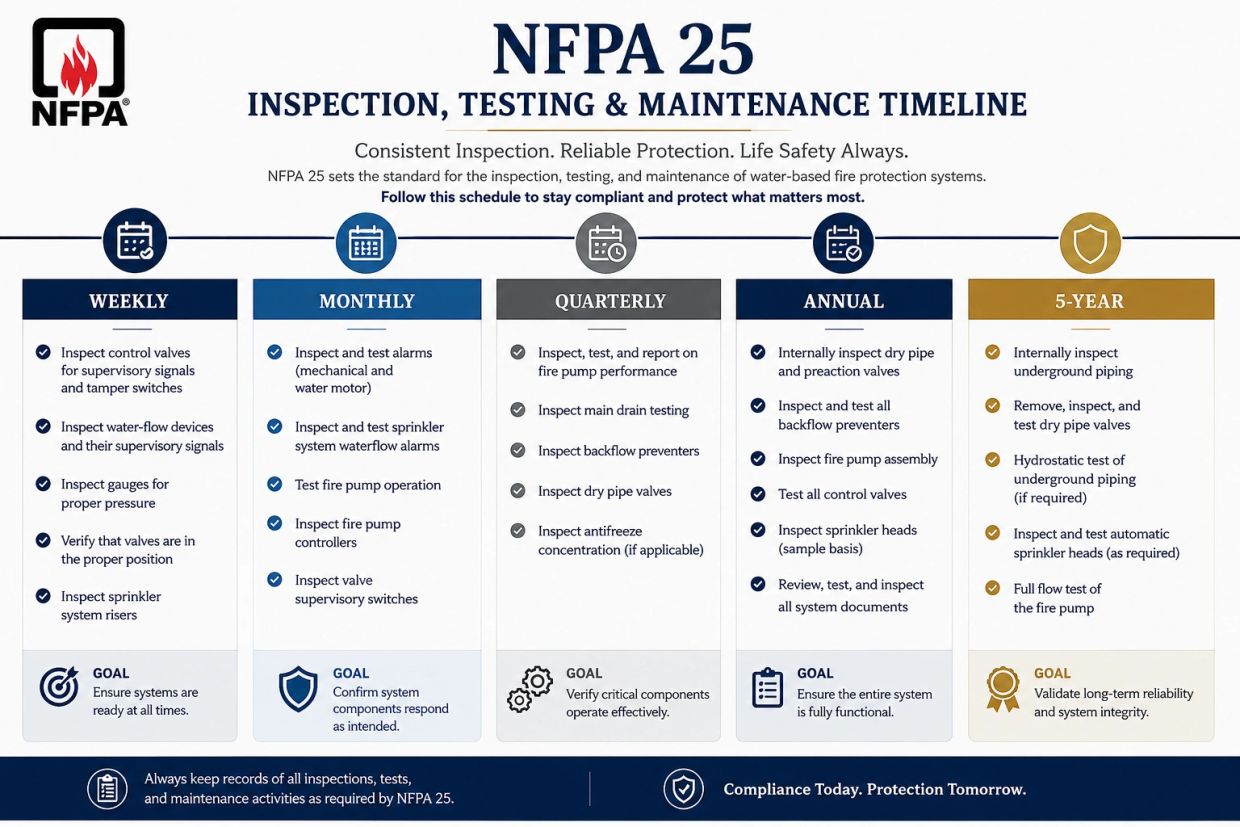
One reason building owners fall out of compliance is that they treat "fire sprinkler inspection" as a single annual event. NFPA 25 is actually the Standard for the Inspection, Testing, and Maintenance of Water-Based Fire Protection Systems, and those three words mean three different activities on three different schedules.
You need all three, on their required intervals, to be compliant. Passing one annual inspection does not cover the quarterly tests or the five-year internal check. The rest of this guide walks through each interval.
Fire sprinkler inspections are not a recommendation. They are a legal requirement.
The North Carolina Fire Code requires that fire protection systems be inspected, tested, and maintained in working order. Section 901.6 of the Fire Code directs owners to the referenced national standards, and for water-based fire sprinkler systems that standard is NFPA 25. In other words, "maintain your system per NFPA 25" is written into the code that applies to your building.
North Carolina's Fire Code is part of the North Carolina State Building Code, built on the International Fire Code with North Carolina amendments. The statewide code sets the minimum, but enforcement happens locally through your Authority Having Jurisdiction (AHJ), usually your city or county Fire Marshal or fire code official. In Raleigh, that is the City of Raleigh Office of the Fire Marshal; Durham, Cary, Apex, Wake Forest, and Chapel Hill each have their own. Your AHJ can inspect your property, ask to see your inspection records, and cite you for deficiencies.
The reason behind the requirement is straightforward. A fire sprinkler system sits idle for years and is expected to work perfectly the one time it is ever needed. In the meantime it degrades silently. Valves get closed and forgotten. Pipes corrode from the inside. Gauges drift out of calibration.
Sprinklers get painted over, loaded with dust, or blocked by new shelving and ductwork. None of that shows up until an inspection catches it, or until a fire does. Regular inspection, testing, and maintenance is how you find those failures before they matter.
NFPA 25 sets a tiered schedule. Different components are checked at different intervals, from weekly all the way out to every five years. The exact list depends on the type of system you have (wet pipe, dry pipe, pre-action, or deluge), but the framework below applies to most commercial buildings, which run wet pipe systems.
These are visual checks that building staff can be trained to perform. They do not replace a professional inspection, but skipping them can be cited as a compliance gap, and they catch the most common problem in the whole system: a control valve that someone closed and never reopened.
Monthly checks on a typical wet pipe system include:
On dry pipe, pre-action, and deluge systems, gauges and enclosure heating are checked weekly rather than monthly, unless the system is electronically monitored, in which case the interval extends to monthly. Cold-climate components get watched more closely, which matters in North Carolina winters.
Every three months, a set of alarm and supply components is inspected and, in the case of alarms, tested:
Quarterly testing of the waterflow alarm is one of the most commonly missed requirements, because owners assume the annual inspection covers everything. It does not.
Certain components are checked twice a year. On most systems this includes valve supervisory and waterflow alarm switches, and, where present, mechanical water-motor alarm gongs. Your provider will confirm which semi-annual items apply to your specific system and your local AHJ's requirements.
The annual inspection is the comprehensive one, and it is the record your fire marshal and your insurer most want to see.
A compliant annual service includes:
Every finding is documented, pass or fail, with any deficiency described and a corrective action noted.
Some of the most important checks happen only twice a decade, which is exactly why they get forgotten:
Backflow prevention assemblies carry their own testing requirement, often annually, driven by the local water authority's cross-connection control rules in addition to NFPA 25. Your provider should coordinate that so it does not fall through the cracks between two sets of rules.
This is the requirement that surprises the most building owners. Sprinklers are not "install once and forget." NFPA 25 requires that sprinklers be tested or replaced at defined ages, because the heat-sensitive element and the seal degrade over decades.
A representative sample is pulled and lab-tested rather than replacing every head at once. The sample is the greater of four sprinklers or one percent of the sprinklers in the sample area. If the sample fails, all sprinklers it represents must be replaced.
The testing ages, by sprinkler type:
A note on the ranges above: NFPA revised several of these intervals in recent editions (fast-response moved from 20 to 25 years, dry sprinklers from 10 to 20). The exact figure that applies to your building is set by the edition of NFPA 25 your local AHJ enforces, so confirm the number with your inspector rather than assuming.
Separate from age, a sprinkler must be replaced immediately any time it is found painted, corroded, loaded with dust or grease, physically damaged, or leaking. Painting a sprinkler, even a light overspray from a remodel, can insulate the heat element and stop it from ever activating. Sprinklers are never to be painted by anyone other than the manufacturer.
The main drain test is one of the most valuable few minutes of the whole annual inspection, and one of the most misunderstood.
The test is simple: the inspector fully opens the main drain valve on the riser, records the water pressure before and during flow, then closes it and records the pressure again. What it reveals is not simple. A significant drop from your building's baseline flow reading points to a partially closed valve somewhere upstream, an obstruction in the supply, or a problem with the municipal water supply feeding the building. In other words, it is the single fastest way to catch the most dangerous failure a sprinkler system can have: water that cannot get to the sprinklers.
This is why the baseline matters. The reading is only meaningful compared to previous readings, which is one more reason to keep continuous records and to use a provider who tracks your history rather than treating each visit as a blank slate.
North Carolina winters are mild compared to the Northeast, but they are cold enough to freeze a water-filled sprinkler pipe in an unheated space, and a frozen sprinkler system is a system that will not work and may burst and flood the building.
NFPA 25 requires that areas containing wet pipe systems be verified to stay above 40°F before the onset of freezing weather. That means checking that valve rooms, attics, concealed spaces, and perimeter areas are actually being heated, and that the heat did not quietly fail since last winter.
Where a space genuinely cannot be kept warm, such as a parking deck, a loading area, a walk-in cooler, or an unheated warehouse, the building will typically use a dry pipe system (charged with air instead of water until a sprinkler opens) or an antifreeze loop. Antifreeze loops have their own annual requirement: the solution concentration must be tested before winter, because a loop that has been topped off with water over the years can become diluted to the point where it no longer protects against freezing. This is a routine, easy-to-miss failure that a good annual inspection catches every fall.
If your building has any unheated protected space, freeze protection should be a specific line item on your annual inspection ahead of the cold season, not an afterthought.

Passing the inspection is only half of compliance. You also have to be able to prove it.
North Carolina requires that inspection, testing, and maintenance records be kept on the premises for at least three years and made available to the fire code official on request. Your AHJ, your insurance carrier, and a fire marshal can all ask to see current records, and "the system works, we just don't have the paperwork" is not a defense.
Incomplete or missing records expose building owners to real liability, regardless of whether the system actually functioned. If an incident occurs and you cannot produce current documentation, you face:
A complete inspection report should include:
A qualified contractor provides this as a standard part of the service. If your current provider hands you a one-line "passed" receipt with no detail, that is a red flag, both for compliance and for whether the inspection was actually thorough.
Most failures are not dramatic. They are small, gradual problems that were never caught. The most common include:
Nearly all of these develop gradually between inspections, which is exactly why the weekly and monthly staff checks and a consistent professional schedule matter. A closed valve caught next month is a two-minute fix. The same valve caught after a fire is a catastrophe.
This is where North Carolina is stricter than many building owners realize, and where choosing the wrong provider can leave you non-compliant even after you have paid for an inspection.
In North Carolina, inspecting and testing a water-based fire sprinkler system requires a Fire Sprinkler Inspection Contractor license. That license is issued by the North Carolina State Board of Examiners of Plumbing, Heating and Fire Sprinkler Contractors, not by the fire marshal. To hold it, the contractor must carry NICET Level III certification in the Inspection and Testing of Water-Based Systems and pass the board's examination. It is a specific, separate credential, and not every company that calls itself a "fire protection" company actually holds it.
When you choose a provider for your sprinkler inspections, verify:
An inspection performed by an unlicensed provider is not just lower quality. It may not be recognized as valid by your AHJ, which puts you right back where you started, out of compliance, after paying for work that does not count.
Zgoda Fire Protection holds North Carolina Fire Sprinkler Inspection Contractor License #L.32557 and is NICET Level III certified in the inspection and testing of water-based systems.
Tracking inspection intervals across weekly, monthly, quarterly, semi-annual, annual, and five-year requirements, on top of running your building, is where most owners and managers fall behind. The deadlines stack up, staff turns over, priorities shift, and something gets missed. Usually it is the quarterly waterflow test or the five-year internal inspection, precisely because they do not happen every year to stay top of mind.
The most reliable approach is to put the whole schedule in the hands of one licensed provider who manages it for you. Rather than tracking every interval yourself, the provider reaches out when each service is due, performs the required inspection and testing, documents it to standard, and keeps your building continuously compliant with no gaps.
For properties that also require fire alarm inspection and fire extinguisher service, bundling every routine under one provider on one schedule removes the burden of coordinating multiple vendors and calendars, and means one accountable point of contact for all of it.
Please reach us at zgodafire@gmail.com if you cannot find an answer to your question.
NFPA 25 sets a tiered schedule and North Carolina Fire Code Section 901.6 makes it a requirement. Building staff perform weekly or monthly visual checks. Alarm and flow devices are inspected and tested quarterly. A full inspection, including a main drain test, is required annually. An internal inspection of the piping is required every five years.
A full physical inspection of sprinklers, pipe, fittings, hangers, and bracing; a main drain test to confirm water supply; testing of antifreeze loops and dry, pre-action, or deluge valves; inspection of the fire department connection, gauges, and alarm devices; a check of the spare sprinkler stock; and complete documentation of every finding.
Yes. NFPA 25 requires sprinklers to be tested or replaced at set ages: standard sprinklers at 50 years, fast-response sprinklers at 20 to 25 years, and dry sprinklers at 10 to 20 years, depending on the code edition your AHJ enforces. Any sprinkler that is painted, corroded, loaded, or damaged must be replaced immediately regardless of age.
The inspector opens the main drain on the riser and records water pressure before, during, and after flow. A significant drop from your building's baseline reading points to a closed valve or an obstruction in the water supply, which is the most dangerous failure a sprinkler system can have. It is a quick test that catches a critical problem.
The deficiency is documented and must be corrected and retested. Depending on severity, your fire marshal may require corrective action within a set timeframe, and an out-of-service system may require a fire watch until it is restored. Unresolved failures can result in code violations, fines, and insurance complications.
Yes. North Carolina requires inspection, testing, and maintenance records to be kept on the premises for at least three years and made available to the fire code official on request. Missing records can result in violations and liability exposure regardless of whether the system actually works.
Inspecting water-based sprinkler systems in North Carolina requires a Fire Sprinkler Inspection Contractor license from the North Carolina State Board of Examiners of Plumbing, Heating and Fire Sprinkler Contractors, which requires NICET Level III certification in the inspection and testing of water-based systems. Confirm any provider holds it before hiring them.
Yes. Unheated areas need freeze protection, usually a dry pipe system or an antifreeze loop, and NFPA 25 requires heated spaces to be verified above 40°F before winter and antifreeze concentration to be tested annually. Freeze protection should be a specific item on your fall inspection.
Zgoda Fire Protection serves commercial properties throughout the greater Triangle, including Raleigh, Durham, Chapel Hill, Cary, Apex, and Wake Forest, plus surrounding communities.
No. Zgoda Fire is licensed for the inspection, testing, and maintenance of existing water-based systems, not new installation or system design. If you need a system installed, expanded, or modified, call and we will refer you to a trusted, licensed installation partner.
Copyright © 2026 Zgoda Fire Protection - All Rights Reserved.
NICET Certified | NC Fire Sprinkler Inspection Contractor #L.32557 | NC Electrical License #U.39068 | Locally Owned, Raleigh NC | Serving the Triangle Since 2017