Signed in as:
filler@godaddy.com
Signed in as:
filler@godaddy.com

What a North Carolina child care center needs to pass its yearly fire inspection and keep its license: the inspection itself, monthly fire drills, your emergency plan, alarms, heaters, exits and records.
This guide is for owners and directors of licensed child care centers in North Carolina, church-based preschools and weekday programs, and property managers who lease space to a child care tenant. Family child care homes follow a shorter set of rules, covered near the end.
North Carolina licenses a child care center when it cares for three or more preschool-age children, or nine or more school-age children (G.S. 110-86). The fire code then puts most centers into one of two day care groups:
Which group your building is in changes things like sprinklers and where each age group's rooms can be. Your local fire inspector or building official makes that call, so ask before you plan around it.
North Carolina law requires every licensed child care center to be inspected at least once a year by the local fire department (G.S. 110-91). The state's child care rules set out how that works (10A NCAC 09 .0304):
This is stricter than the fire code's own schedule. The North Carolina Fire Code sets the fire marshal's minimum for educational buildings, which includes a Group E day care, at once every two years. State law for child care centers overrides that and makes it every year.
Church-based programs are not exempt. Religious-sponsored child care is excused from a few licensing requirements (G.S. 110-106), but not from the fire inspection. A new religious-sponsored program must send in a fire inspection within 30 days of opening, and after that it documents compliance every year "using the same forms and in the same manner as for all other centers" (10A NCAC 09 .2101).
The day you pass, put the next due date on the calendar.
The fire inspection is done by the fire department for the town your center is in, not by a private company.
Ask a few weeks before the 12-month date, not on it. If the inspection has to be rescheduled, or an item fails and needs a second visit, you still have time inside the window.
The child care rules require two kinds of drills (10A NCAC 09 .0604):
A lockdown drill never counts as your fire drill for the month. The North Carolina Fire Code says lockdown drills "shall not be substituted for fire and evacuation drills" (Section 404.2.3.2).
What to write down. For each fire drill: the date, the time, how long it took to get everyone out of the building, and the signature of the person who ran it (10A NCAC 09 .0302). For each lockdown or shelter drill: the date, the time, how long it took to reach the safe spot, and a signature. Keep drill records at least one year (10A NCAC 09 .2318).
The state's drill log form says drills should happen "at unexpected times and under varying conditions." A drill at nap time, or with one exit treated as blocked, tests what a mid-morning drill does not.
If you care for infants or other children who cannot walk, the center must have an evacuation crib or similar device: on wheels, with a reinforced bottom, and able to fit through the designated fire exit. It has to be used during every fire, lockdown and shelter drill. If the building does not meet the code for an institutional occupancy and an exit is more than eight inches above the ground outside, the center must write a plan for getting the crib out, the state must approve it, and the state will watch the center use it during a drill (10A NCAC 09 .0604).
Every center needs a written Emergency Preparedness and Response Plan (10A NCAC 09 .0607):
When you move a classroom, add a room or change an exit, update the evacuation diagram at the same time. The plan has to match the building you have now.
A licensed center needs a manual fire alarm system, even a small one. The fire code normally lets a small Group E building, with 50 occupants or fewer, go without a manual fire alarm system. North Carolina changed that rule so the exemption does not apply to licensed child care centers (North Carolina Fire Code 907.2.3).
The system has to be inspected and tested on the schedule set by NFPA 72, the national fire alarm standard. Our Fire Alarm Guide walks through what that inspection covers. If you are adding or replacing a system, see our post on installing a fire alarm system in a North Carolina daycare.
Carbon monoxide. Existing Group I-4 buildings must have carbon monoxide alarms, and they are allowed to run on batteries alone (North Carolina Fire Code 1103.9). In new buildings, carbon monoxide detection is required in Group I-4 and in Group E classrooms when the building has something that can produce it, such as a fuel-burning appliance or a fireplace (Section 915.1.1).
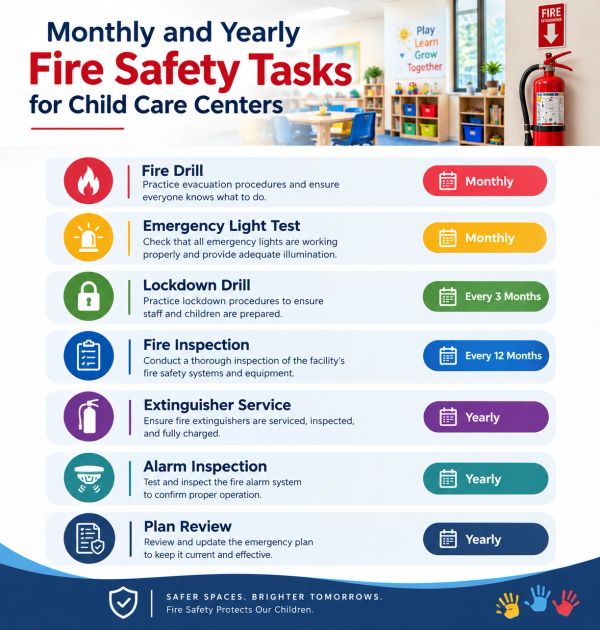
Fire extinguishers must be selected, installed and maintained to NFPA 10 (North Carolina Fire Code 906.2), which means professional service every year. The child care rules add one that is easy to miss: every vehicle used to transport children must carry a fire extinguisher (10A NCAC 09 .1003). See our fire extinguisher service page for what the yearly service includes.
Emergency lighting must get an activation test every month: unplug or switch off normal power and confirm the emergency lights come on and stay lit (North Carolina Fire Code 604.6.1). Self-testing units only need a visual check every 30 days. Exit signs must be lit (Section 1013.3), so replace a dead bulb or a failed sign as soon as you see it. See our emergency lighting page.
North Carolina has a day care rule many centers don't know about: "Unvented fuel-burning heaters and portable electric heaters of all types are prohibited" in adult and child day care facilities (North Carolina Fire Code 603.5.3). That includes the small electric heater under a teacher's desk.
The same section allows masonry fireplaces, listed fuel-burning space heaters, fireplaces and floor furnaces only when a protective screen is securely attached. The child care rules add two more:
North Carolina's building code has rules about where children can be cared for in a building. They matter most when you are leasing a space, moving, or starting to use a new room:
Talk to your fire inspector or building official before you sign a lease or move a classroom upstairs. Changing a room after you have moved in costs more than choosing the right one at the start.
A family child care home is a licensed program in the operator's own home, caring for more than two and fewer than 11 children (G.S. 110-86). Homes follow their own rules:
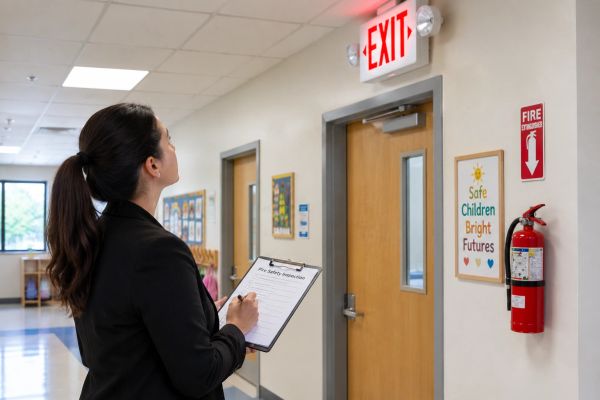
Before your inspection date, run through this list:
If your fire alarm, extinguishers or emergency lights are due, Zgoda Fire can service them before your inspection.
Call (919) 368-7464, or see how we work with schools and child care centers across the Triangle.
Please reach us at chris@zgodafire.com if you cannot find an answer to your question.
A licensed child care center needs a fire inspection by the local fire department at least once a year. The next one is due within 12 months of the last one, and the center is responsible for scheduling it. The approved report goes to the NC Division of Child Development and Early Education within one week.
The local fire department or fire marshal's office for the town the center is in. In Raleigh, request a Daycare Inspection through the Office of the Fire Marshal. Centers on State property are inspected by an official designated by the Office of State Fire Marshal.
Every month, plus a shelter-in-place or lockdown drill at least every three months. A lockdown drill does not count as a fire drill.
The date, the time, how long it took to evacuate the building, and the signature of the person who ran the drill. Keep the records at least one year.
Not a portable electric heater of any kind, and not an unvented fuel-burning heater. The North Carolina Fire Code prohibits both in child day care facilities.
Yes, if it is a licensed child care center. North Carolina removed the small-building exemption for licensed child care centers, so they need a manual fire alarm system regardless of size.
Yes. Religious-sponsored programs are exempt from some licensing requirements, but not the fire inspection. A new program sends in a fire inspection within 30 days of opening and documents compliance every year after that.
State law does not require a yearly fire inspection for a family child care home the way it does for a center. Homes need any inspections their local ordinances require, plus monthly fire drills, the required smoke detectors and a fire extinguisher.
Zgoda Fire Protection serves schools, child care centers and other commercial properties throughout the Triangle, including Raleigh, Durham, Chapel Hill, Cary, Apex and Wake Forest, plus surrounding communities.
Copyright © 2026 Zgoda Fire Protection - All Rights Reserved.
NICET Certified | NC Fire Sprinkler Inspection Contractor #L.32557 | NC Electrical License #U.39068 | Locally Owned, Raleigh NC | Serving the Triangle Since 2017