Signed in as:
filler@godaddy.com
Signed in as:
filler@godaddy.com
Installation, inspection, testing, and repair of emergency lighting, exit signs, and egress illumination for commercial properties across the Triangle. Tested on schedule, documented for your fire marshal, and repaired in house.
Emergency lighting is the easiest thing in a commercial building to forget. It sits on the ceiling doing nothing for years. There is no alarm when it stops working. A battery that died eighteen months ago looks exactly like a battery that is fully charged.
Then the power goes out, and the one system whose entire job is to get people out of a dark building does not come on.
Fire inspectors know this, which is why emergency lighting and exit signs are among the most commonly cited deficiencies in commercial buildings. The lights are usually there. They are usually mounted correctly. They just do not hold a charge anymore, and nobody tested them.
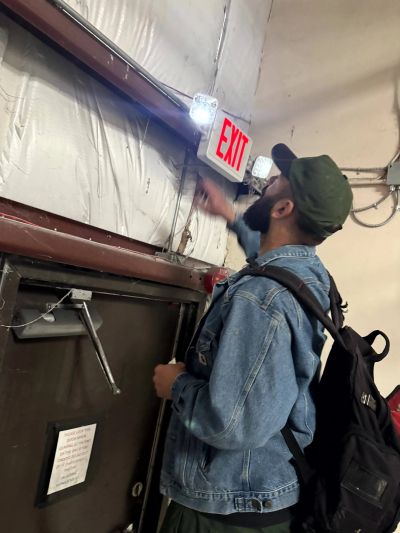
Zgoda Fire Protection installs, inspects, tests, and repairs emergency lighting and exit signs across the Raleigh-Durham-Chapel Hill Triangle, on the schedule the code requires, with the documentation your fire marshal asks for.
Emergency lighting is not optional equipment and testing it is not a recommendation.
The North Carolina Fire Code, built on the International Fire Code with North Carolina amendments, requires the means of egress in commercial buildings to be illuminated whenever the space is occupied, and requires emergency power to illuminate exit routes when normal power fails. Exit signs must be placed so that one is visible along the egress path, and they must be illuminated.
The performance requirements are specific:
And the testing schedule, which is where most buildings fall down:
Those two tests are different in kind, not just in length. A 30-second test tells you the unit switches over. Only the 90-minute test tells you the battery can actually last as long as the code requires. A battery degraded to twenty minutes of capacity passes the monthly test every single time and fails the people in the building.
Records of this testing must be maintained and available for your fire code official on request. Enforcement is local: the City of Raleigh Office of the Fire Marshal is the authority inside Raleigh, and Durham, Cary, Apex, Wake Forest, and Chapel Hill each have their own.

Emergency lighting is a category, not a single fixture. Zgoda Fire Protection handles all of it:
Whether your building runs individual battery units, a central inverter, or a mix of both, the same schedule applies and we test all of it together.
Most buildings do not have an accurate count of their emergency lighting. Fixtures get added during renovations, exit signs get moved, and nobody updates a list. We walk the property and build an inventory of every emergency light, exit sign, and egress fixture, along with its location and condition.
That inventory becomes the basis for everything after, and it is the thing your fire marshal implicitly expects you to have.
We perform the 30-second functional test and the annual 90-minute duration test to code, on the interval each requires. Every unit is tested individually, not sampled.
Anything that fails is documented with its location, what failed, and what it needs.
This is where most providers hand you a report and leave.
A failed emergency light is an electrical repair. It means a battery, a ballast or driver, a lamp head, a wiring fault, or a full fixture replacement on a hardwired circuit. Zgoda Fire Protection holds an Unlimited Classification Electrical Contractor License from the North Carolina Board of Examiners (#U.39068), so the same company that finds the deficiency corrects it. No subcontracted electrician, no second scheduling window, no gap between the inspection that found the problem and the repair that closes it.
The monthly test is the requirement buildings miss most, because it is monthly, it is tedious, and it never feels urgent.
Zgoda Fire Protection offers recurring emergency lighting routines that put the whole schedule on autopilot. We track when your annual 90-minute test is due, handle the testing, document every unit, and flag what needs replacing before it becomes a citation.
Most properties bundle it with the rest of their fire protection: fire alarms annually, sprinklers on the NFPA 25 schedule, extinguishers annually, suppression systems semi-annually, and emergency lighting on its own cycle. One provider, one schedule, one point of contact.
Sign up once and stop tracking it yourself.
Electrical work handled in house. The Unlimited Classification Electrical Contractor License (#U.39068) means testing and repair are the same visit and the same company. Most fire protection vendors can test your emergency lighting but have to subcontract the fix.
One provider for the whole building. Fire alarms, sprinkler inspections, suppression systems, clean agent systems, extinguishers, and emergency lighting under one schedule, with no gaps between trades and nobody pointing at another vendor.
Documentation that holds up. Every unit tested, logged by location, with pass or fail results, deficiencies described plainly, and corrective action noted. The record your fire marshal asks for, not a one-line receipt.
You work with the same team. When you call Zgoda Fire, you reach Christopher and his team. The people who survey your building are the people who test it and pick up the phone when something goes wrong.
Locally owned, serving the Triangle since 2017.
Zgoda Fire Protection serves commercial and industrial properties throughout the greater Raleigh-Durham-Chapel Hill Triangle, including Raleigh, Durham, Chapel Hill, Cary, Apex, Wake Forest, and Fayetteville.
We serve commercial and industrial properties only, including office buildings, warehouses, retail, restaurants and commercial kitchens, data centers, medical and assisted living facilities, schools, and industrial plants. We do not provide residential services.
Please reach us at zgodafire@gmail.com if you cannot find an answer to your question.
Two tests are required. A functional test every 30 days, running each unit for at least 30 seconds to confirm it switches to battery and illuminates. And an annual test running the full 90 minutes to confirm the battery holds the required duration. Records must be kept and made available to your fire code official on request.
It is the annual test that runs each emergency light on battery power for a full 90 minutes, the minimum duration the code requires the system to operate after a power failure. It is the only test that proves the battery still holds a real charge. A degraded battery with twenty minutes of capacity will pass a 30-second monthly test every time.
The most common causes are batteries that no longer hold a 90-minute charge, burned out or missing lamp heads, exit signs that are not illuminated, fixtures that were added during a renovation and never wired to emergency power, obstructed or missing exit signage, and no testing records on file. Most are inexpensive to correct once identified.
Yes. Where exit sign illumination is required by code, the signs must be illuminated and must remain illuminated on emergency power for the required duration when normal power fails. Exit signs must also be placed so the path of egress is marked and a sign is visible along the route.
Building staff can perform the 30-day functional test if they are trained to do it and it is documented properly. The annual 90-minute test is more involved, requires every unit to run for the full duration, and is where failures actually surface, so it is normally performed and documented professionally. We can cover the full schedule, or set your staff up to handle the monthly checks while we take the annual. Either way the records stay complete.
The deficiency is documented and must be corrected. Your AHJ can issue a correction order with a deadline, and depending on severity and occupancy, a significant egress lighting impairment can carry further requirements until it is restored. Unresolved deficiencies can lead to code violations and insurance complications.
Both. Zgoda Fire Protection designs, installs, inspects, tests, and repairs commercial emergency lighting and exit signs. Because we hold an Unlimited Classification Electrical Contractor License, installation and repair are handled entirely in house.
Yes. Self-testing and self-diagnostic units run the functional test automatically and flag a fault with an indicator light, which cuts down the manual monthly burden considerably. They still need to be verified, maintained, and documented, and the indicator only helps if somebody is actually checking it. If your building is a good candidate for them, we will tell you during the survey.
Commercial properties throughout the greater Triangle, including Raleigh, Durham, Chapel Hill, Cary, Apex, Wake Forest, and Fayetteville.
If you cannot produce a current testing record for every emergency light and exit sign in your building, that is the place to start. We will survey what you have, test it to code, document it, and fix what fails.
Copyright © 2026 Zgoda Fire Protection - All Rights Reserved.
NICET Certified | NC Fire Sprinkler Inspection Contractor #L.32557 | NC Electrical License #U.39068 | Locally Owned, Raleigh NC | Serving the Triangle Since 2017