Signed in as:
filler@godaddy.com
Signed in as:
filler@godaddy.com

Round-the-clock central station monitoring for commercial fire alarm, sprinkler, and suppression systems across the Triangle. Signals answered in seconds, the fire department dispatched for you, and the connection tested and documented to code.
An unmonitored fire alarm does exactly one thing. It makes noise inside the building.
If the building is full, someone hears it and calls 911. If it is two in the morning, a holiday weekend, or a warehouse with nobody on site, the alarm sounds to an empty room. The fire department finds out when a neighbour notices smoke, which is usually a long time later.
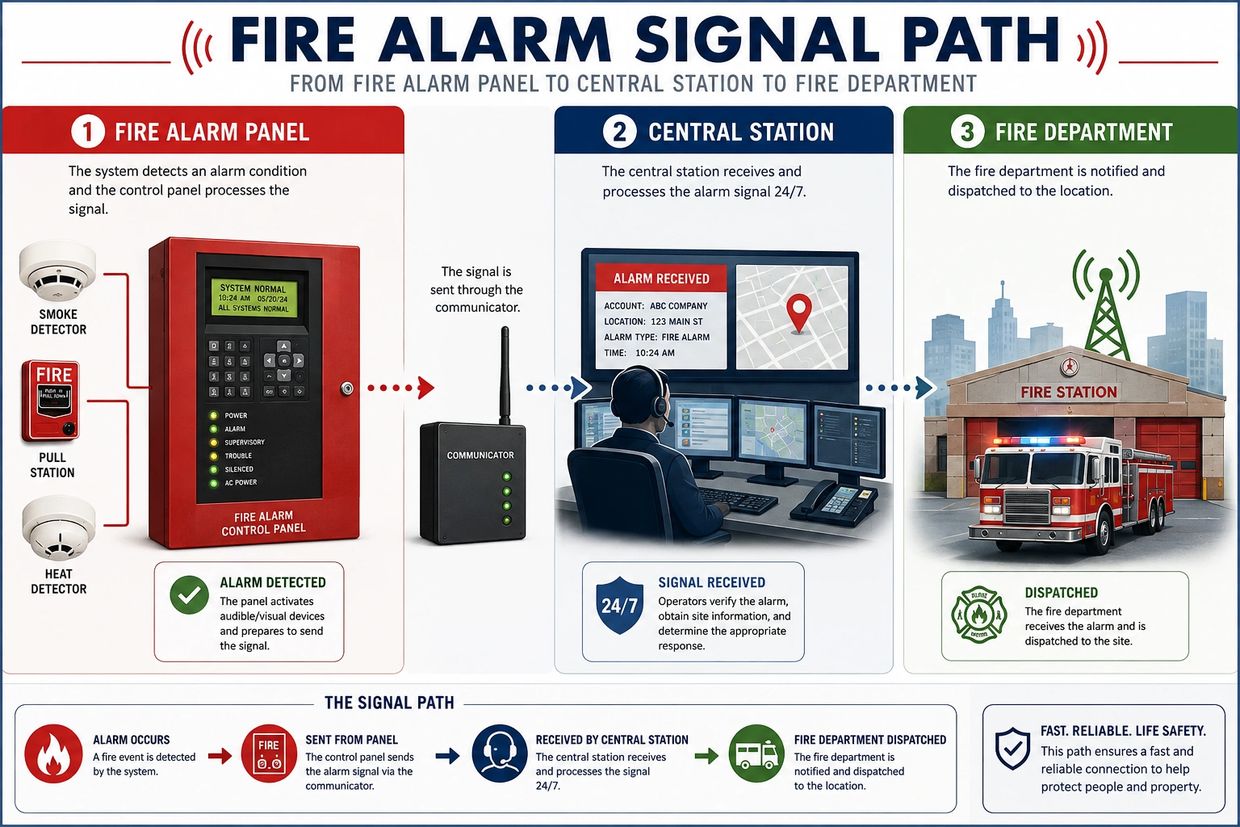
Monitoring is what closes that gap. Your panel is connected to a central station staffed 24 hours a day, every day of the year. When a signal comes in, an operator answers it in seconds and dispatches the fire department whether anyone is in your building or not.
It is also, for most commercial buildings in North Carolina, not optional.
Zgoda Fire Protection provides 24/7 monitoring for commercial fire alarm, sprinkler, and suppression systems across the Raleigh-Durham-Chapel Hill Triangle, on the same account as your inspections, from the same company that services the system.

If you are not certain which of these catches your building, that is a five minute phone call, not a research project. Call us and we will tell you.
We do not treat monitoring as an upsell that some buildings take and others skip.
Every fire alarm panel Zgoda Fire installs or services is monitored. That is the standard, and it is the standard because an unmonitored commercial panel is almost always either a compliance problem waiting to be found or a real safety gap waiting to be paid for.
It also removes an argument that costs buildings badly. When the alarm company and the monitoring company are two different vendors, a failed signal path is nobody's fault. The alarm company says the panel is fine. The monitoring company says nothing arrived. Both are telling the truth and the building is still unmonitored.
One company holding both means there is one number to call and no one to point at.
Monitoring is not only about smoke. Your system reports three distinct kinds of signal and all three matter.
Zgoda Fire monitors commercial fire alarm systems, fire sprinkler systems for waterflow and valve supervision, and fire suppression systems including kitchen hood and clean agent systems.
We monitor fire and life safety only. We do not sell or monitor burglar alarms, intrusion detection, or security cameras. Fire protection is the whole business, and it is the only thing we ask you to trust us with.
This is the question most building owners never think to ask, and it is the one that decides how fast the fire department arrives.
Zgoda Fire monitors through Security Central, a wholesale central station headquartered in Statesville, North Carolina, family owned and operating since 1963. Your building's signals are answered in state, not routed to an out-of-state call centre that has never heard of your fire marshal.
What that facility carries:
Before anything else, we look at how your panel communicates today, which is frequently not how it communicated when it was installed.
The single most common monitoring failure in commercial buildings is a phone line change. The building moved to VoIP or digital phone service, nobody told the fire alarm vendor, and the traditional communicator stopped transmitting. The panel keeps showing green. The system can sit unmonitored for months and look completely normal from inside the building.
We check the path, confirm whether it is supervised, and tell you plainly what you have.
Where the communicator needs replacing or upgrading, we handle it. Most commercial systems today use a cellular communicator, an IP connection over the building's network, or both together for redundancy. Cellular removes the dependency on building phone lines entirely, which is why it is the usual answer for a retrofit.
This is fire alarm and electrical work, and Zgoda Fire holds an Unlimited Classification Electrical Contractor License from the North Carolina Board of Examiners (#U.39068), so it is done in house. No subcontracted electrician, no second vendor, no scheduling gap between the company that sold you monitoring and the company that has to make it work.
We then set up your account at the central station, including the call list of who gets contacted and in what ord
Monitoring is not a set-and-forget service, and NFPA 72 does not treat it as one. The communication path and the central station connection have to be tested as part of your regular inspection and testing schedule.
We test it, document it, and keep your account details current. When your inspection report goes to your fire marshal, the monitoring is on it.

Monitoring is billed as a recurring service and you choose the cycle. Monthly keeps it as a small predictable line item. Annual is a single invoice once a year and one less thing on the calendar.
Most of our clients fold monitoring into a full fire protection routine rather than running it as a standalone account: fire alarms inspected annually, sprinklers on the NFPA 25 schedule, extinguishers annually, suppression systems semi-annually, emergency lighting on its own cycle, and monitoring running underneath all of it.
One provider, one schedule, one invoice, one number to call. Set it up once and stop tracking it yourself.
A lapse is almost never noticed by the building owner in the ordinary course of business, because nothing about it is visible from inside the building. It surfaces in one of three ways, in ascending order of expense.
At inspection. The inspector tests the communication path, finds the signal is not reaching the central station, and writes it up as a deficiency. This is the good outcome. It gets corrected and retested.
At a fire marshal visit. Your AHJ asks for proof of monitoring and the contract has lapsed or the path is dead. Depending on occupancy and severity that can mean a correction order with a deadline, and in some cases a fire watch, meaning a person physically patrolling the building on a set rounds schedule until the system is restored. A fire watch runs 24 hours a day and is expensive.
At an incident. The alarm activates, nothing transmits, and response is delayed by however long it takes a human being to notice. This is where the insurance and liability exposure stops being theoretical.
The company that monitors it is the company that services it. No finger pointing between an alarm vendor and a monitoring vendor when a signal path fails. One account, one accountable contact.
Electrical work handled in house. The Unlimited Classification Electrical Contractor License (#U.39068) means communicator upgrades, panel work, and repairs happen on our visit, not on a subcontractor's schedule.
One provider for the whole building. Fire alarms, sprinkler inspections, suppression systems, clean agent systems, extinguishers, emergency lighting, and monitoring under one schedule, with no gaps between trades.
Documentation that holds up. Monitoring appears in your inspection records with the communication path tested and results logged, which is what your fire code official is actually asking for.
You work with the same team. When you call Zgoda Fire you reach Christopher and his team. The people who survey your building are the people who service it and pick up the phone when something goes wrong.
Locally owned, serving the Triangle since 2017.
Zgoda Fire Protection serves commercial and industrial properties throughout the greater Raleigh-Durham-Chapel Hill Triangle, including Raleigh, Durham, Chapel Hill, Cary, Apex, Wake Forest, and Fayetteville.
We serve commercial and industrial properties only, including office buildings, warehouses, retail, restaurants and commercial kitchens, data centers, medical and assisted living facilities, schools, and industrial plants. We do not provide residential services.
Please reach us at zgodafire@gmail.com if you cannot find an answer to your question.
In most cases yes. The rule is that a fire alarm system required by the code must be monitored by an approved supervising station. Separately, if your building has a fire sprinkler system, its valve and waterflow supervision must transmit to a supervising station. Higher-risk occupancies carry stricter requirements, your local fire marshal can make monitoring a condition of occupancy, and many insurance policies require it independent of code. Most commercial buildings are caught by at least one of these.
A facility staffed 24 hours a day, every day of the year, that receives signals from your fire alarm panel and dispatches the fire department. Zgoda Fire monitors through Security Central, a UL Listed, FM Approved, TMA Five Diamond certified central station headquartered in Statesville, North Carolina, with additional monitoring centres in Tennessee and South Carolina for redundancy.
It depends on the system, the number of signals, and whether it is bundled with your inspection schedule. Monitoring is billed as a recurring service and you choose monthly or annual billing. Call us with your building details and we will price it on the phone.
Traditional two-line phone monitoring is largely obsolete and is not reliable over VoIP or digital phone service. Most commercial systems now use a cellular communicator, an IP connection, or both for redundancy. If your building changed phone or internet service and the alarm communicator was never updated, there is a real chance your system is not transmitting at all right now.
You usually cannot tell from inside the building, which is the problem. A panel showing normal status proves nothing about whether the signal reaches anyone. The things to check are whether you have a current monitoring contract and know who holds it, what communication path the panel uses today, whether that path is supervised so a failure gets reported, and whether the path is tested and documented in your inspection reports. If you cannot answer the first two, call us and we will check it.
An alarm signal means a fire condition was detected. A supervisory signal means something protective changed state, such as a sprinkler control valve being closed. A trouble signal means the system itself has a fault, such as a low battery or a failed communication path. All three are transmitted and all three matter.
No. They are separate obligations and neither covers the other. Monitoring reports what your system detects right now. Inspection confirms the system can still detect anything at all. A monitored panel with a decade of dust in its smoke detectors will faithfully transmit nothing, because nothing is being detected. NFPA 72 also requires the communication path itself to be tested on schedule.
All of them. We monitor commercial fire alarm systems, fire sprinkler systems for waterflow and valve supervision, and fire suppression systems including kitchen hood and clean agent systems.
No. Zgoda Fire monitors fire and life safety systems only. We do not sell or monitor intrusion alarms or security cameras.
Yes, and it is a common request. We check what your panel currently transmits and how, move the account to our central station, verify the signals are being received, and set up your call list. If the communicator needs upgrading we handle that in house.
Commercial properties throughout the greater Raleigh-Durham-Chapel Hill Triangle, including Raleigh, Durham, Chapel Hill, Cary, Apex, Wake Forest, and Fayetteville.
If you cannot say with certainty who is monitoring your fire alarm, what path it uses, and when it was last tested, that is worth ten minutes. We will check what you have, tell you plainly whether it is compliant, and quote monthly or annual if it is not.
Copyright © 2026 Zgoda Fire Protection - All Rights Reserved.
NICET Certified | NC Fire Sprinkler Inspection Contractor #L.32557 | NC Electrical License #U.39068 | Locally Owned, Raleigh NC | Serving the Triangle Since 2017